JIULIAN Electromechanical supports scrubber system design, fabrication, installation, retrofit and commissioning for chemical manufacturing plants. The project scope can coordinate the scrubber, ductwork, industrial fan, recirculation system, dosing controls, drainage, electrical works and maintenance access as one integrated exhaust-treatment package.
In a chemical manufacturing plant, exhaust conditions do not always remain constant. A production change, higher batch rate, different raw material, cleaning cycle, tank-filling activity or process upset can alter the fume concentration, gas temperature, moisture level and exhaust volume.
When equipment is selected only from nominal airflow or a standard catalogue size, the scrubber may run continuously without providing stable capture, treatment or operating control.
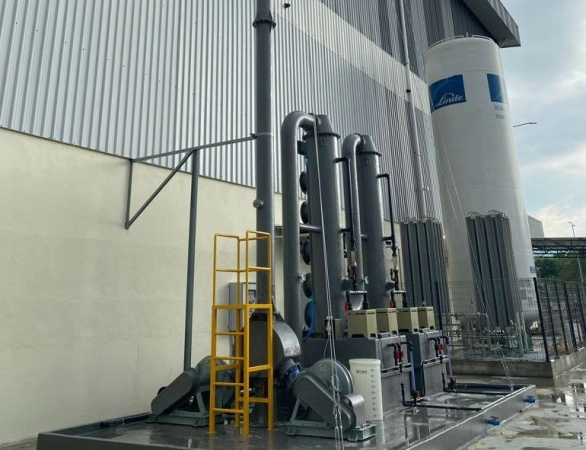
It is part of the production exhaust system, chemical-handling system, drainage arrangement, electrical-control system and daily plant-operation routine. Each interface should be reviewed before the equipment is fabricated or installed.
Increasing the pump capacity, adding more chemical or installing a larger fan may not correct the actual failure. The complete exhaust path should be reviewed before deciding which component needs modification.
Incompatible exhaust streams may have been combined, or intermittent sources may create a peak load that was not included in the original design basis.
Temperature, moisture, concentration and airflow may be higher or more variable than the values used when the scrubber was selected.
A material described generally as chemical resistant may still be unsuitable for the actual chemical concentration, temperature, condensation or joint construction.
Recirculation, chemical dosing, pH measurement, water make-up and blowdown may not be balanced against the actual contaminant loading.
Fan selection must consider losses through hoods, ducting, bends, dampers, scrubber packing, spray zones, mist eliminators and the discharge stack.
Restricted access can make pumps, nozzles, packing, mist eliminators, instruments, drains and fan components difficult to inspect or replace.
The correct scrubber configuration depends on more than the contaminant name. JIULIAN reviews how the process behaves during normal production, batch transitions, cleaning, start-up, shutdown and foreseeable upset conditions.
The design basis should identify the acids, alkalis, soluble gases, aerosols, vapours, particulate matter and odour-forming compounds expected in the exhaust.
Corrosion risk is affected by the gas, liquid, temperature, concentration, condensation, outdoor exposure, fabrication method and drainage arrangement.
Depending on verified process conditions, a project may involve PP, PVC, FRP, stainless steel or a combination of materials for the tower, ducting, pipework, pump components, seals and supports.
More chemical does not automatically improve absorption. The dosing system must operate together with gas loading, circulation rate, liquid-to-gas contact, pH range, tank volume, make-up water and blowdown.
The fan must maintain capture at the source while overcoming the resistance of the complete installed system. An oversized or undersized fan can create unstable capture, high power use, excessive noise or liquid carry-over.
Retrofit projects require verification of existing duct material, dimensions, leakage, supports, fan location, electrical supply, drainage points and available installation space.
The proposal should also define which duct sections can be retained, modified, isolated or replaced.
Commissioning should establish a practical operating condition and give the plant team clear inspection points. The design should allow safe access for routine work after handover.
A scrubber can only treat contaminants that are captured and transported to it. Poor hood placement, open tanks, uncontrolled cross-drafts, leaking ductwork or an unbalanced branch system can allow fumes to escape before treatment.
The review should therefore follow the complete exhaust path:
For general industrial scrubber information, visit the JIULIAN Industrial Scrubber System Malaysia page. This chemical-manufacturing page focuses specifically on process variation, corrosive service, chemical control, retrofit interfaces and long-term plant operation.
JIULIAN reviews the project as an integrated exhaust-treatment package rather than supplying an isolated scrubber vessel. The confirmed scope depends on the process, available information, site condition and client requirements.
Yes, some installations can be improved by retaining suitable components and replacing or modifying only the parts that no longer match the operating requirement. The decision must follow a site and condition assessment.
The installation sequence should identify work that can be completed before the shutdown, components that can be pre-fabricated off-site, isolation requirements, lifting access and the final tie-in window.
The project is developed from process and site information, followed by coordinated engineering, fabrication, installation and commissioning.
| Project stage | What JIULIAN focuses on | Why it matters |
|---|---|---|
| Process and site review | Exhaust sources, chemical characteristics, operating pattern, existing ductwork, utilities, access and site constraints. | Prevents the proposal from being based only on nominal airflow or incomplete drawings. |
| System engineering | Scrubber configuration, materials, airflow path, pressure loss, liquid circulation, dosing, drainage and controls. | Aligns the equipment with the real chemical and mechanical duty. |
| Fabrication coordination | Dimensions, connection points, construction materials, transport limitations and approved site measurements. | Reduces avoidable changes when the equipment arrives on site. |
| Installation | Equipment position, duct connections, fan integration, electrical works, supports, drainage and access provisions. | Helps prevent clashes between mechanical, electrical and civil work. |
| Testing and commissioning | Major connections, operating sequence, pump and fan operation, controls, alarms and practical readiness. | Identifies installation or control issues before routine operation. |
| Follow-up support | Inspection, cleaning, troubleshooting, replacement and future modification. | Supports long-term reliability as production requirements change. |
A coordinated scope gives the chemical plant, consultant and procurement team a clearer view of equipment, interfaces, access work and responsibilities before installation starts.
| Project issue | Equipment-only or split approach | Coordinated JIULIAN project approach |
|---|---|---|
| Design basis | Scrubber may be selected from limited flow and contaminant data. | Process variation, material exposure, airflow and site interfaces are reviewed together. |
| Duct and fan | Separate suppliers may use different assumptions for pressure loss. | The fan, duct route, scrubber and mist eliminator are considered as one airflow system. |
| Chemical control | Dosing equipment may be supplied without a complete liquid-management strategy. | Dosing, pH control, recirculation, make-up water and blowdown are coordinated. |
| Site installation | Access, lifting and tie-in requirements may appear as later variations. | Site constraints and installation sequencing are reviewed before the practical scope is finalised. |
| Maintenance | Clearance may only be checked after equipment placement. | Access to pumps, packing, nozzles, sensors, drains and mist eliminators is planned earlier. |
| Responsibility | System issues may be passed between the equipment, duct, fan and electrical contractors. | Major agreed interfaces are coordinated within one project workflow and defined scope. |
A useful quotation starts with process and site information. The following six items help reduce assumptions and make competing proposals easier to compare.
Identify the tanks, reactors, mixing points, filling areas or cleaning activities involved and provide chemical names or safety data where available.
Provide measured or estimated flowrate, duct dimensions, gas temperature, shift pattern and production schedule.
Explain batch changes, cleaning cycles, maximum production rate and any known condition that creates higher fumes or temperature.
Share drawings, duct sizes, fan information, stack details, scrubber model, electrical supply, drainage points and available installation space.
State whether the main issue is odour, visible fume, corrosion, poor capture, high chemical usage, liquid carry-over, maintenance difficulty or expansion.
Confirm whether the work is a new installation, replacement, capacity upgrade or retrofit, together with the shutdown window and access restrictions.
Site photos, a simple process description, chemical information and a sketch of the current layout can help JIULIAN identify which measurements or inspections should be completed during a site assessment.
Chemical or process type:
[Insert the verified chemical category or process, such as acidic
mixing fumes, alkaline treatment fumes or chemical-tank ventilation.]
Original problem:
[Insert the verified issue, such as recurring odour, duct corrosion,
unstable pH, insufficient extraction or increased production demand.]
JIULIAN implementation scope:
[Insert the confirmed scope, such as scrubber fabrication, duct
replacement, fan upgrade, pump and dosing system, control panel,
installation and commissioning.]
Verified outcome:
[Insert a factual result, such as completed installation, restored
exhaust operation, improved maintenance access or successful handover.]
Chemical plant exhaust projects commonly affect duct routes, industrial fans, power supplies, controls, equipment supports, drainage and existing facility services. These related JIULIAN resources help project teams define the wider scope.
JIULIAN combines scrubber-system capability with mechanical, electrical and civil engineering support. This is useful when a project involves more than equipment supply and requires modification of an operating industrial facility.
Scrubber, ductwork, fan, controls, electrical supply, structural support, drainage and site interfaces can be reviewed under a coordinated project scope.
Direct coordination between design, fabrication and installation teams helps reduce gaps when verified site conditions require practical adjustment.
Project planning can consider restricted access, safety permits, phased work, production constraints and controlled shutdown windows.
The scope can be discussed for a new production line, capacity upgrade, equipment replacement, system troubleshooting or long-term maintenance need.
Whether you are installing a new chemical production line, upgrading an existing exhaust-treatment system or resolving repeated scrubber performance problems, send JIULIAN your process description, chemical information, drawings and site photos.
JIULIAN serves chemical manufacturing and industrial projects in Selangor, Kuala Lumpur, Klang Valley, Sendayan and other Malaysian locations subject to project scope and site requirements.
a scrubber system for a chemical manufacturing plant should be designed for the real process—not only a nominal airflow value. Exhaust composition, production variation, corrosion, liquid chemistry, pressure drop, existing ductwork, controls, commissioning and maintenance access all affect whether the installed system can operate reliably.
JIULIAN Electromechanical can coordinate the scrubber, ducting, fan, dosing, electrical and retrofit requirements as one practical project scope. Start by providing the process source, chemical information, current symptoms, available drawings and expected shutdown window.
JIULIAN ELECTROMECHANICAL (MALAYSIA) TRADING SDN. BHD offers HVAC, cleanroom, electrical and civil engineering services in Selangor, Malaysia. Contact us for a quote today.
20-7, Menara Mutiara Sentral, No. 2, Jalan Desa Aman 1, Cheras Business Centre, 56000 Kuala Lumpur, Malaysia.
© 2025-2026 JIULIAN ELECTROMECHANICAL (MALAYSIA) TRADING SDN. BHD 202501041271 (1642680-P)